


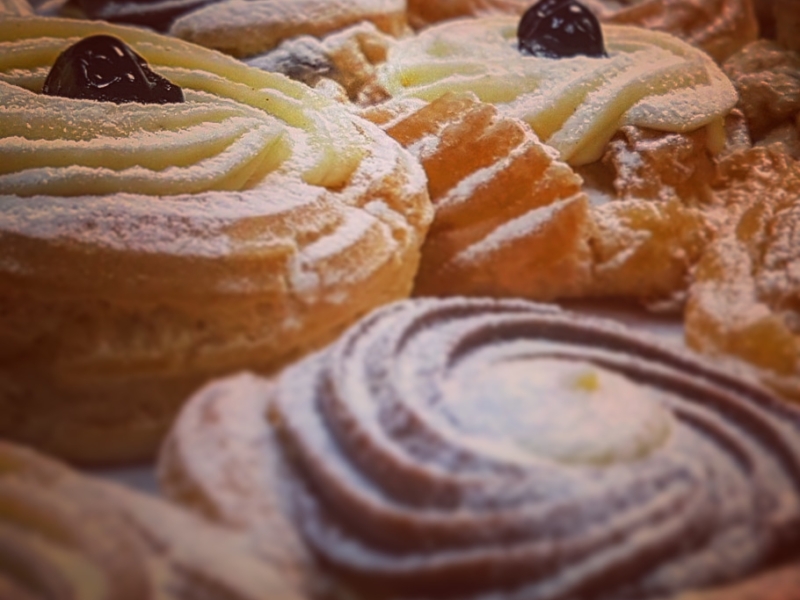
The Authentic Recipe for Father’s Day
On 19 March, St. Joseph’s Day, also celebrated as Father’s Day in Italy, traditional Zeppole di San Giuseppe take centre stage on our tables and in pastry shops throughout the country.
Zeppole di San Giuseppe originate from the culinary traditions of Campania, a region not far from our beautiful Abruzzo. Today, however, you can find many delicious variations all across Italy!
From fried to oven-baked zeppole, from the classic version filled with pastry cream and sour cherries to tempting creations featuring chocolate, pistachio and much more!
HISTORY
The origins of zeppole, just like those of other traditional festive treats such as Cicerchiata, are rooted in ancient traditions and legends dating all the way back to 500 BC.
The most widespread legend has Christian origins. According to tradition, St. Joseph, in order to support Mary and Jesus, worked not only as a carpenter but also as a travelling seller of fried pastries.
Some believe that the word “zeppola” comes from the Latin serpula(m), meaning “snake”, referring to the pastry’s characteristic spiral shape.
Others suggest that the name derives from the Latin cippus, a term associated with a woodworking tool in Naples. This would therefore explain the connection between the name of the pastry and St. Joseph’s profession as a carpenter
For Father’s Day, let’s discover the authentic recipe for this delicious traditional Italian treat!
INGREDIENTS for 16 oven-baked Zeppole
FOR THE CHOUX PASTRY:
- 120 g water
- 100 g eggs (2 medium eggs)
- 75 g Italian 00 flour
- 60 g butter
- A pinch of salt
- 350 g pastry cream
- Sour cherries in syrupù
- Icing sugar
EQUIPMENT NEEDED
- Piping bag
- Large open-star piping nozzle (8–10 mm diameter)
PREPARATION
First, let’s prepare the choux pastry. In a saucepan, bring the water, butter and salt to a boil. Remove from the heat, add all the sifted flour at once and stir with a whisk.
Return the saucepan to the heat and continue cooking, stirring with a wooden spoon. When a thin white film forms on the bottom of the saucepan and the dough begins to sizzle, it is ready. Allow the mixture to cool slightly, then transfer it to a bowl and add the eggs, one at a time. (It is advisable to beat the eggs separately in a small bowl, so you can add just the right amount according to the consistency of the dough.)
Once the mixture is smooth, glossy and sticky, transfer it to a piping bag fitted with a star-shaped nozzle. Then, pipe the dough into ring shapes onto a baking tray lined with parchment paper, leaving a little space between each one.
Bake in a preheated oven at 220°C for 10 minutes, then reduce the temperature to 180°C and continue baking for approximately 30–35 minutes. Remove from the oven and allow the zeppole to cool completely. Next, transfer the pastry cream to a piping bag and pipe it onto the zeppole, which have already been dusted with icing sugar. Finish by decorating each zeppola with sour cherries in syrup
FUN FACTS
Before sugar became widely available, honey was used as a sweetener. Similarly, before olive oil was used to make zeppole, lard was traditionally used for frying.